
•Introduction
Mombasa Blue is a water filtration concept designed around existing household jerricans.
Developed from an open brief on water security in Mombasa, Kenya, the concept responds to contamination risks during household handling by bringing filtration into two everyday actions: drawing water for drinking and transferring it between jerricans.
Context
Year
Type
Role
Collaboration
Semester Project at Lund University
2021
Team Project
Industrial Designer
Sony Europe, UNOPS
•Challenge
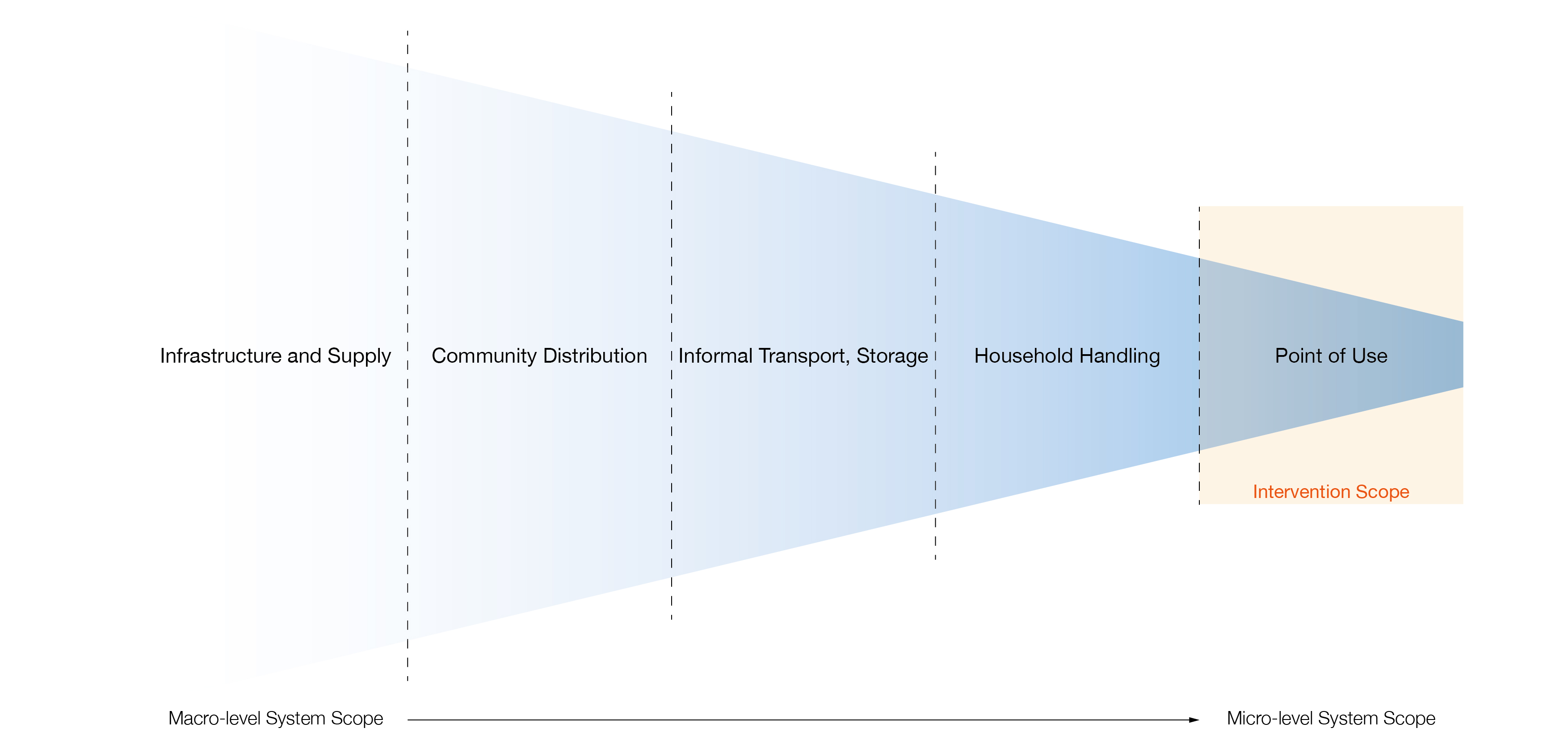
The point of use offers a final opportunity to treat water before drinking.
Water security in Mombasa spans multiple stages, each presenting different problems and possible directions for design.
We chose the point of use because water can still be treated there, regardless of what has happened upstream. It also allows a household-level product to act directly on the water before consumption, without requiring changes to the wider supply and distribution system.
•Household Water Journey
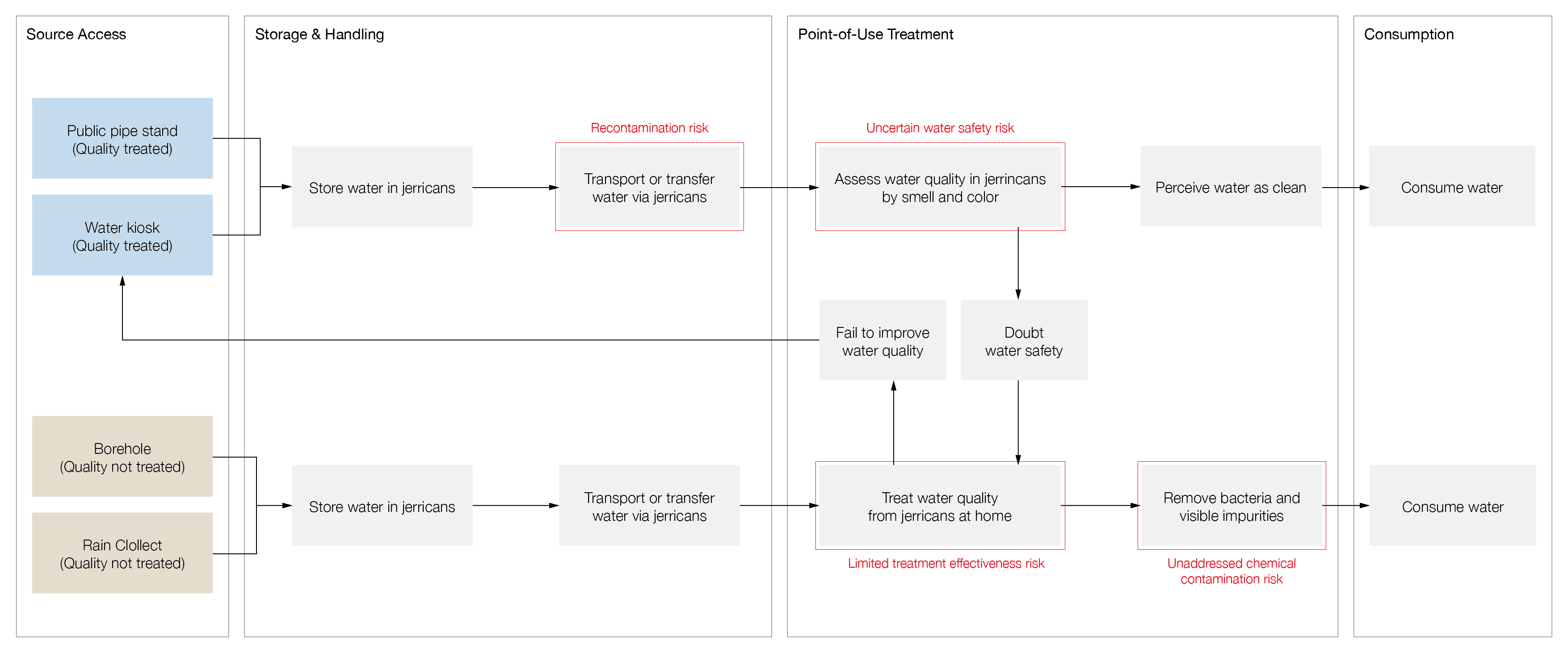
The jerrican is present at almost every step of household water use.
Mapping household water journeys through remote interviews and desk research showed that water can become contaminated again while it is carried, stored and transferred in jerricans. Households often judge water by its colour and smell, which cannot reliably indicate whether it is safe to drink.
As an existing part of these water-handling routines, the jerrican offered an interface for introducing filtration into everyday use.
•Design
A filter that mounts onto the jerrican.
Mombasa Blue attaches to the opening of an existing jerrican. A hand-operated pump draws water up through a filtration unit and into a removable cup, without requiring the container to be lifted or tilted.

Drawing water for drinking.
Water is pumped into a removable cup, which can be lifted off and poured into a drinking glass. The transparent cup keeps the water and its level visible.
01: Mounted on the jerrican.
03: Water drawn through the filter.
04: Filtered water collected in the cup.
Filtering water during transfer.
Transferring water between jerricans is already part of household water routines. For this, the collection cup is removed and tubing connects the device to both containers, allowing the same pump to draw water through the filter during transfer.
01: Collection cup removed.
02: Water pumped between the jerricans.
03: Water passing through the filtration unit.
•Process
How the device relates to the jerrican.
With the jerrican as the interface, we explored four early ideas for how filtration could become part of its use. Quick mock-ups on real jerricans helped compare these relationships before detailed form development.
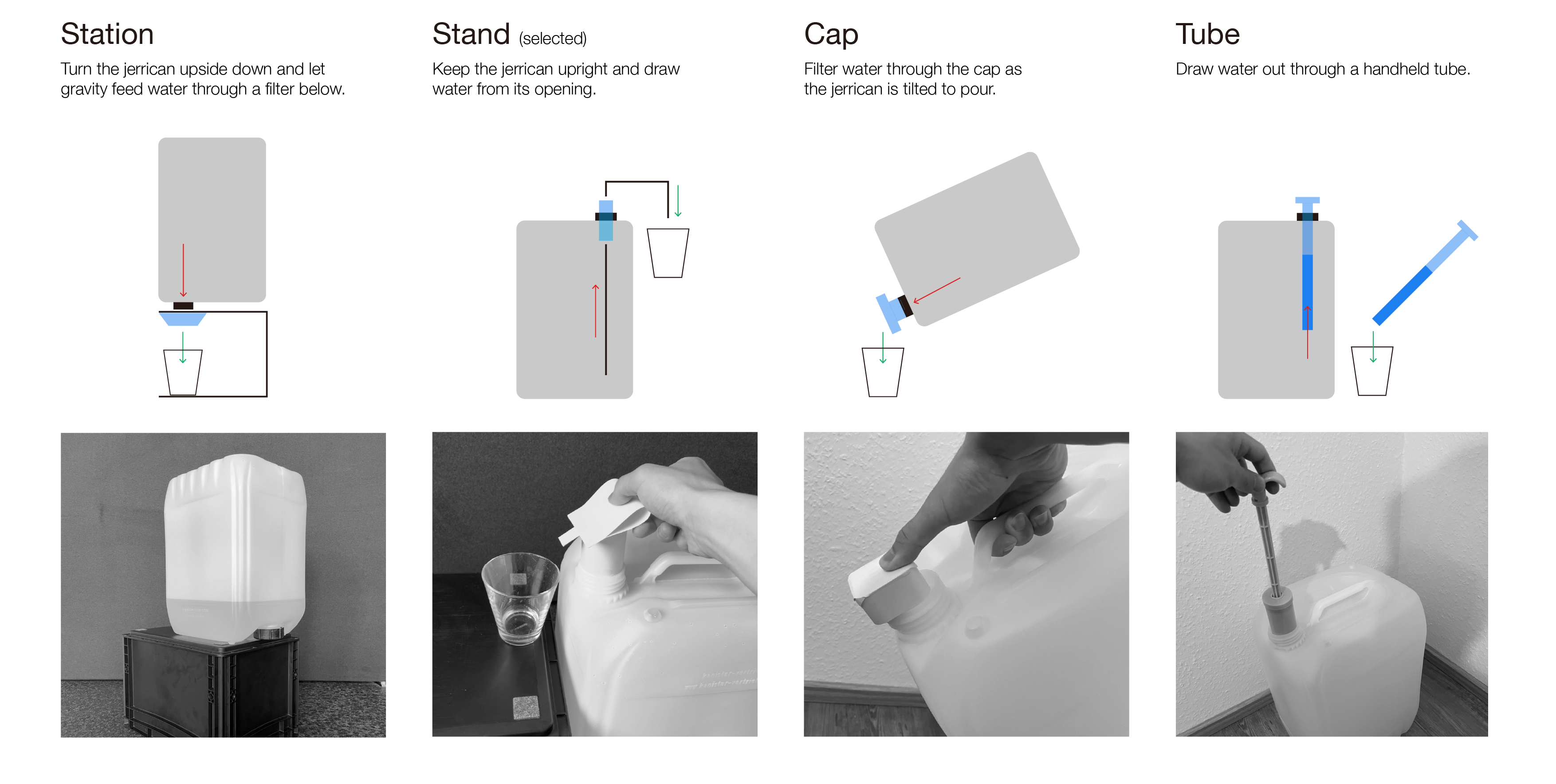
Stand was taken forward mainly for accessibility. Station and Cap both require a full jerrican to be lifted or tilted, which is difficult for many household members, especially children. Stand leaves the jerrican where it is. That created a new problem: water now had to be moved up and out of an upright container.
How the water is moved.
With the jerrican upright, water had to be actively drawn up and out. We compared four motion principles through reference products and a qualitative assessment of how each would be operated and built.
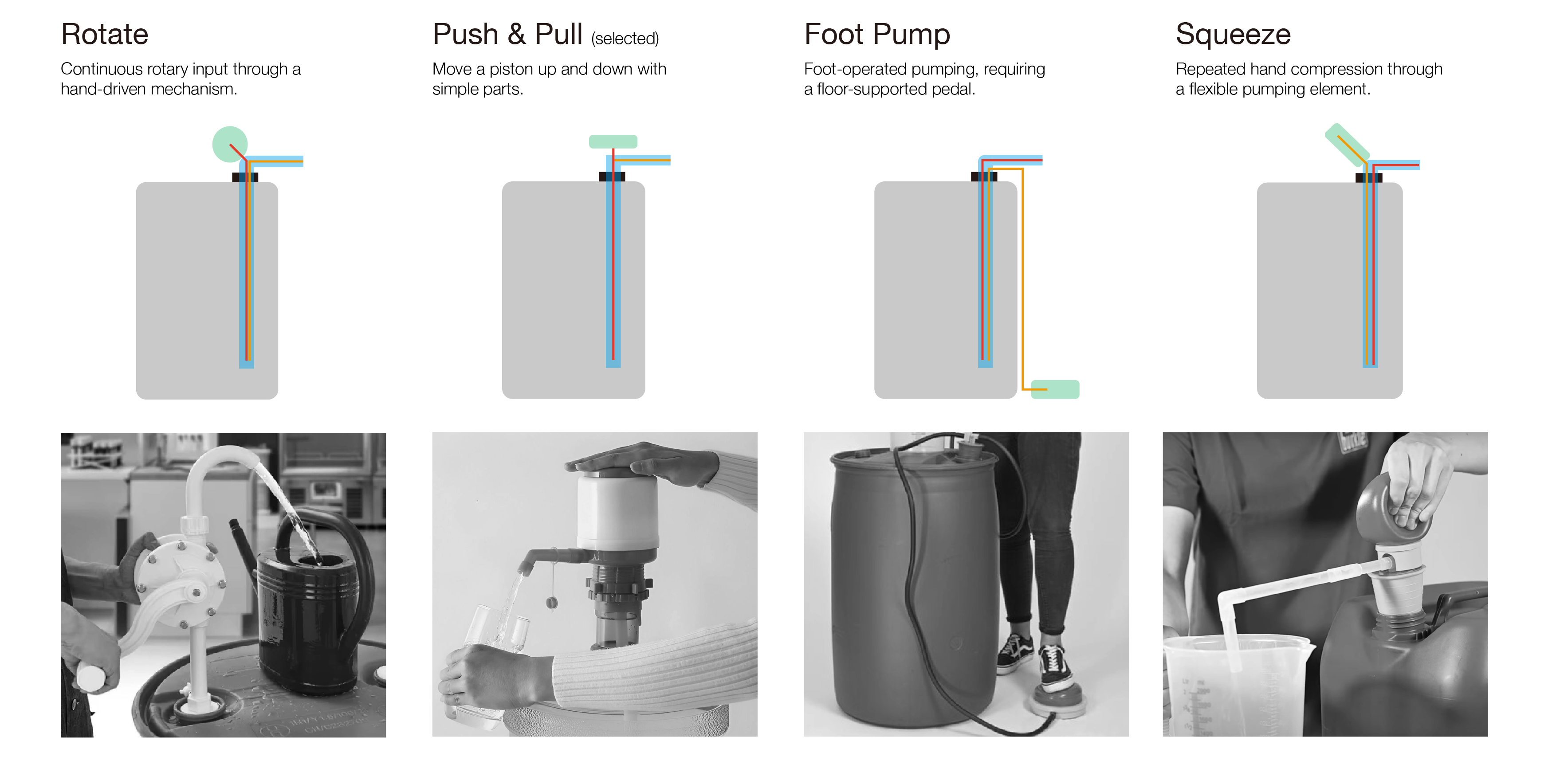
Push & Pull was taken forward because it offered a clear path to a compact hand-operated mechanism with relatively simple moving parts. Operating effort over repeated use remained an open question to test during further development.
From mechanism to product.
Push & Pull defined the motion, but not yet the product. It had to work by hand in two orientations: upright for drinking and horizontal for transfer. A lever enabled the same pumping motion in both and could lower the force required at the handle. The rounded rectangular body followed the same logic, supporting a stable grip upright and a stable contact surface horizontally.
Physical models.
Physical models were used to check the product at human scale: the length and grip of the lever, the size of the housing in the hand, and the movement of the assembled lever mechanism. Fit and clearances between parts were adjusted through the models. The cup lifts off to expose the connection used for water transfer.

•Reflection
1. Where to intervene.
Looking back, the decision that still holds up is where to intervene: at the point of use, through existing household jerricans.
2. What was unproven.
Key questions about how the concept would perform in use remained unanswered. Filtration performance, pumping force and flow were never tested, while materials, sealing and assembly remained at concept level.
3. What I would test first.
I would build simple working rigs much earlier, validate pumping and filtration separately, and only then move into contextual testing and a higher-fidelity prototype.
