population has access to safe clean water despite the rich natural resources around the country.
25%
population has access to safe clean water when it comes to Mombasa, Kenya's second-largest city.
•Research
Desktop Research
Starting observation with a closeup lens on the local environment.
Our research began with a direct exploration of everyday water-related scenarios, allowing us to identify the common practices and distill the current key water challenges: quality concerns, supply shortages, aging infrastructure, and climate variability.
User Interview
Gaining insights from experts and local citizens. In order to narrow the challenge and reveal concrete friction points where design intervention could happen, we decided to dive into the local citizen. Conversations centered on their daily routines (specific moments of collection, storage, and use).
Pain Points Anaysis
Mapping water interactions for in-depth insights. Using insights from user interviews, a user journey map was created to examine how water-related tasks unfold across the day. By mapping existing behaviors alongside coping strategies together, persistent gaps still emerged despite the support of community-driven solutions.
Insights Discovery
Insight 01
Even when water is purified at kiosks or through filtration systems, transporting it in jerricans and improper storage can reintroduce bacteria and contaminants before drinking.
Insight 02
Most community-driven solutions focus on removing bacteria and visible impurities but do not address heavy metals, industrial waste, or chemical pollutants.
Insight 03
Some advanced solutions limit sustained use, causing households to rely on inconsistent or temporary fixes.
Unaddressed chemical contamination.
Post-filtration contamination risk.
Access and affordability barriers.
•Design Definition
How might we create solutions for households in Mombasawho to improve last-mile water quality securitywhat, ensuring affordability, flexibility, and ease of accesshow?
•Design Process
Ideation Phase 01
Ideating from a critical touchpoint.
To tackle the last-mile challenge, initial ideation focused on the local jerrican, as it anchors most water-related activities and marks the final interaction before drinking. This approach grounded concepts in existing behaviors rather than introducing new ones.
Ideation Phase 02
Narrowing mechanisms through performance criteria.
Building on the selected concept from Phase 01, ideation shifted toward developing the filtration mechanism itself. Concepts were then narrowed using performance-driven criteria such as water flow rate efficiency, operating force burden, and manufacturability.
Ideation Phase 03
Refining interaction, ergonomics, and form. Following key decisions in earlier phases, this phase focused on refining the physical interface. Sketching was used to explore ergonomics and interaction details in preparation for further development.
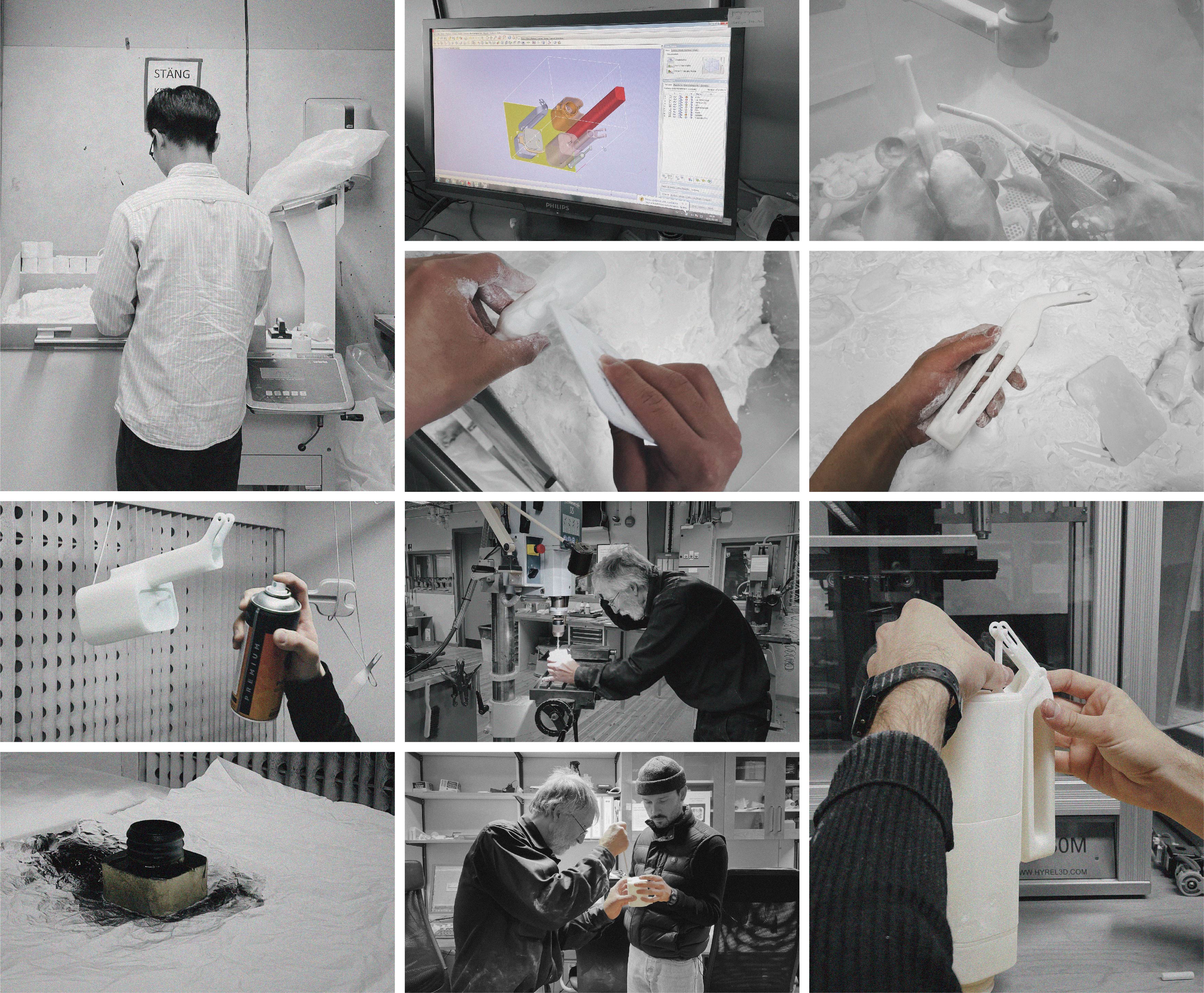
Prototyping
Validating the concept through physical prototyping. With the concept consolidated, this phase focused on producing a higher-fidelity physical prototype to assess physical feasibility, structural integrity, and interaction under more realistic conditions.
•Final Design
The final concept is a household-level water filtration product designed to improve water quality at the last mile of everyday use in Mombasa.
Clean water, secured at the last mile.
Users can filter and drink water directly from the jerrican, reducing contamination risks at the final point of use.
01: Unfold the rubber tube.
02: Connect to the top of the jerrian.
03: Start to pump.
04: Filter the water into the container.
05: Complete.
Water transfer, secured between jerricans.
Water can be transferred between jerricans while remaining filtered, helping ensure stored water stays clean during handling and transport.
01: Remove the container.
02: Connect the tubes to both sides.
03: Connect to the jerricans and start to pump.
04: Water will be filtered to the target jerrican.
05: Complete.
Simple assembly, repair with ease.
The design enables straightforward assembly and disassembly, allowing parts to be repaired or replaced with minimal effort and cost.
Backstage support, full-service experience.
To support the hardware‘s adoption and long-term use, the design is positioned within a lightweight system connecting households, maintenance, and other key touchpoints. A simple digital layer provides access, guidance, and feedback support - helping maintain a reliable and low-friction user experience over time.
1. Purposeful design intervention starts from concrete user friction. When facing a complex system shaped by multiple factors, it is easy to identify numerous areas for potential improvement. This project highlighted that meaningful design intervention does not come from addressing complexity broadly, but from focusing on concrete friction points within users’ daily routines. Grounding decisions in these moments helped narrow the scope and ensured the intervention remained both purposeful and accountable.
2. Make the intangible tangible. Initial interview insights naturally pointed toward visible and tangible issues, such as the current community-driven solutions. However, mapping the full user journey revealed where these solutions quietly failed to carry through everyday use. This process exposed critical gaps at the last mile - issues that were not immediately visible, yet decisive in shaping the final design direction.
3. Looking ahead: questions for further development. (1) From a hardware perspective, this project explored additive manufacturing as a prototyping strategy; translating the design into traditional manufacturing would introduce new constraints that could significantly reshape the form and structure.
(2) Additionally, future development would involve deeper exploration of inner filter materials and technologies to validate filtration performance under real-world conditions. (3) More broadly, this project suggests questions about how products might respond more dynamically to their context. Future exploration could examine how emerging technologies, such as LLMs, enable physical products to better sense usage conditions and adapt interactions accordingly.