•Introduction
This project presents a new approach to trail running shoes:
an adjustable-grip outsole system that allows traction to be adjusted during a run, in response to changing terrain.
Context
Year
Type
Role
Degree Project at Lund University
2022
Individual Project
Industrial Designer
•Challenge
Runners adapt to the ground with every step.
Their shoes do not.
Trail running is defined by constant change: loose gravel, wet rock, steep climbs, sudden descents. Yet most shoes still rely on a fixed traction profile, forcing runners to compromise with every transition. As terrain shifts, runners continuously adjust their posture and pace. When traction can’t adapt, stability breaks and performance drops, especially during rapid uphill-to-downhill phases.
This raised a question: how might footwear adapt its grip dynamically to support runners across mixed terrain within one journey?
•Design
Two grip strategies, one outsole.
On soft ground, grip comes from lugs penetrating the surface. On rock, it comes from as much of the sole as possible staying in contact. A fixed outsole has to choose one and compromise on the other.
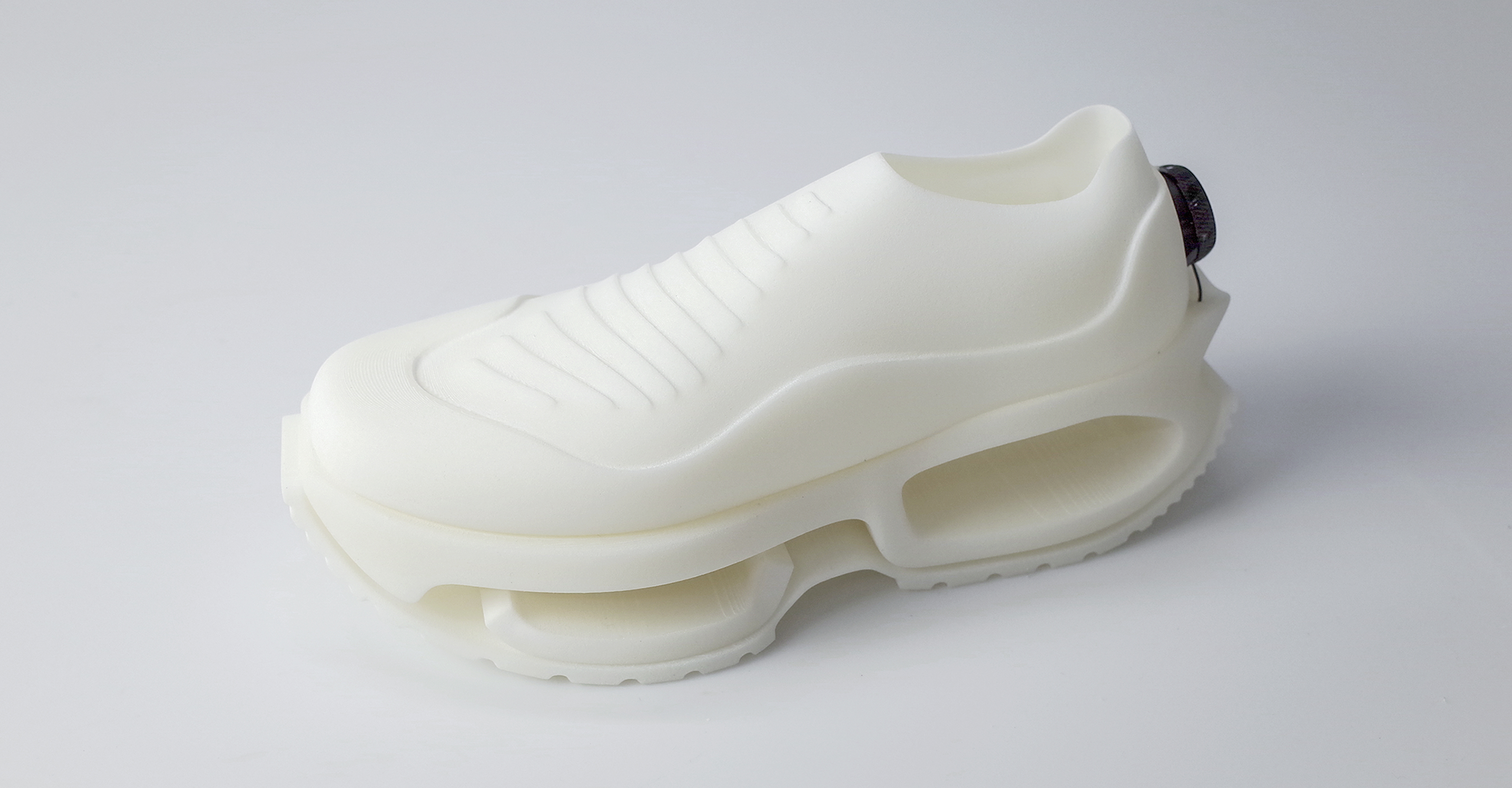
717 changes the geometry instead: the forefoot lugs extend to bite into soft ground, or retract flush to hold contact on hard surfaces.
Everything happens inside the shoe.
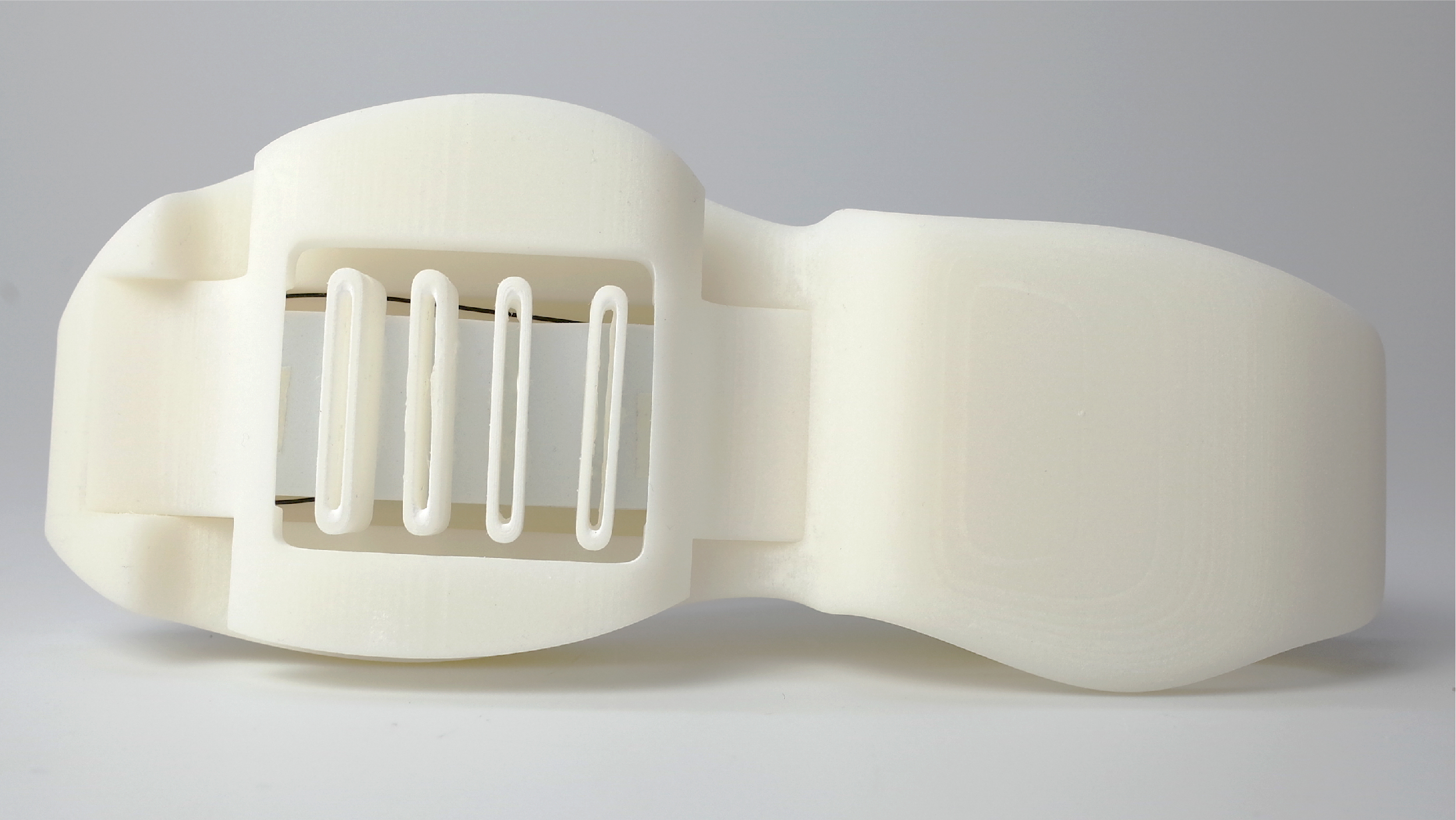
The dial at the heel tensions a cable that runs through the midsole to a flexible TPU plate under the forefoot.
The plate is fixed at its rear side; as tension pulls the front side, the plate flexes downward and drives four rows of lugs out through openings in the outsole. Release the tension and the plate returns to shape, drawing the lugs back in.
The whole mechanism lives between the midsole and the outsole. Nothing is added to the shoe, and nothing is removed from it.
The chain is entirely mechanical, with no sensors and no battery.
The runner sets it by hand, in seconds.
The dial sits at the back of the heel, within reach while standing or walking. A few turns move the lugs. The shoe stays on the foot, and the hand only ever touches the heel.
•Process
Scenario Analysis
Looking at how much of the sole is in contact and which way the load pushes, loose ground and rock fail a shoe in opposite ways. On loose and wet ground the sole slips because nothing breaks the surface. On rock it slips because too little of the sole is touching. Deeper lugs mean less of the sole in contact.
Existing Solutions
Adjustable traction already exists, but always as something added to the shoe or reached through the sole. Chains and spike frames have to be carried, fitted by hand, and taken off again, which takes minutes and breaks the run before the grip changes at all. Hinged studs built into the outsole avoid that, but the runner has to reach under the shoe to flip them.
Ideation
The first three directions all changed grip by changing volume. Like a squeezed ball, an opening flower, an inflating pufferfish: each has to expand or contract, which in a shoe means the sole itself has to grow and shrink. The wave was the only one that changed shape without changing size, a long strip bending and straightening from a fixed end, and could sit inside a midsole instead of around it.
Driving the Structure
The next question was how to drive it. The strip needs a steady pull that holds where it is left, and research led to the BOA fit system, already proven in ski boots and cycling shoes: a dial winds a cable in increments and stays there, fast enough not to break the run and worked with one hand. Sketching put the dial at the heel, where a hand reaches it without the shoe coming off.
Prototyping
The principle was tested before the shoe existed, with foam, cable and a bent strip. Most of the work then went into the plate. It has to bend under the pull of a cable and push the lugs out, then spring back on its own. Different TPU grades and geometries were tested until one did both. The fixed end moved several times before the cable had enough travel.
Form Development
An opening in the midsole keeps the cable and plate in view rather than hiding the adaptive system inside a closed sole. Protection builds around the dial, the midsole opening, and the toe, while a broader edge pattern adds stability.

•Reflection
1. Where the project started.
The idea began with winters in Sweden. I would leave in the morning on dry ground and come back in the evening to ice or wet snow, still in the shoes I had picked for the morning. Hiking gave me the same experience on changing terrain, and trail running is where it becomes most acute, since running leaves less time to react, which is why the project started there.
2. What is untested, and where it goes next.
It has not been tested on a foot. Three things are still open. Whether the dial is as easy to reach mid-run as it is on a bench, how the plate behaves after a few hundred kilometres, and what grit does to the openings once it gets in. The lugs sit flush when retracted, which should help, but the tolerances that would make that work have not been worked out. Testing on a foot, over distance and in real conditions, is where this would go next.
3. The formula.
What this project produced is not only a shoe concept. It is a formula for changing grip: a surface that changes its own shape, set by hand, with no power. The same formula works elsewhere: a commuter facing a road that froze during the day, or an athlete rebuilding confidence on uneven ground after an injury. The mechanism does not change. What changes is why someone reaches for it.