•Introduction
Mombasa Blue is a water filtration concept designed around existing household jerricans.
Developed from an open brief on water security in Mombasa, Kenya, it responds to the risk of contamination during household handling and storage. It brings filtration into two everyday actions: drawing water for drinking and transferring it between jerricans.
Context
Year
Type
Role
Collaboration
Semester Project at Lund University
2021 (12 weeks)
Team Project (Fabian Schray, Eleonora Sandre)
Industrial Designer
Sony Europe, UNOPS
•Challenge
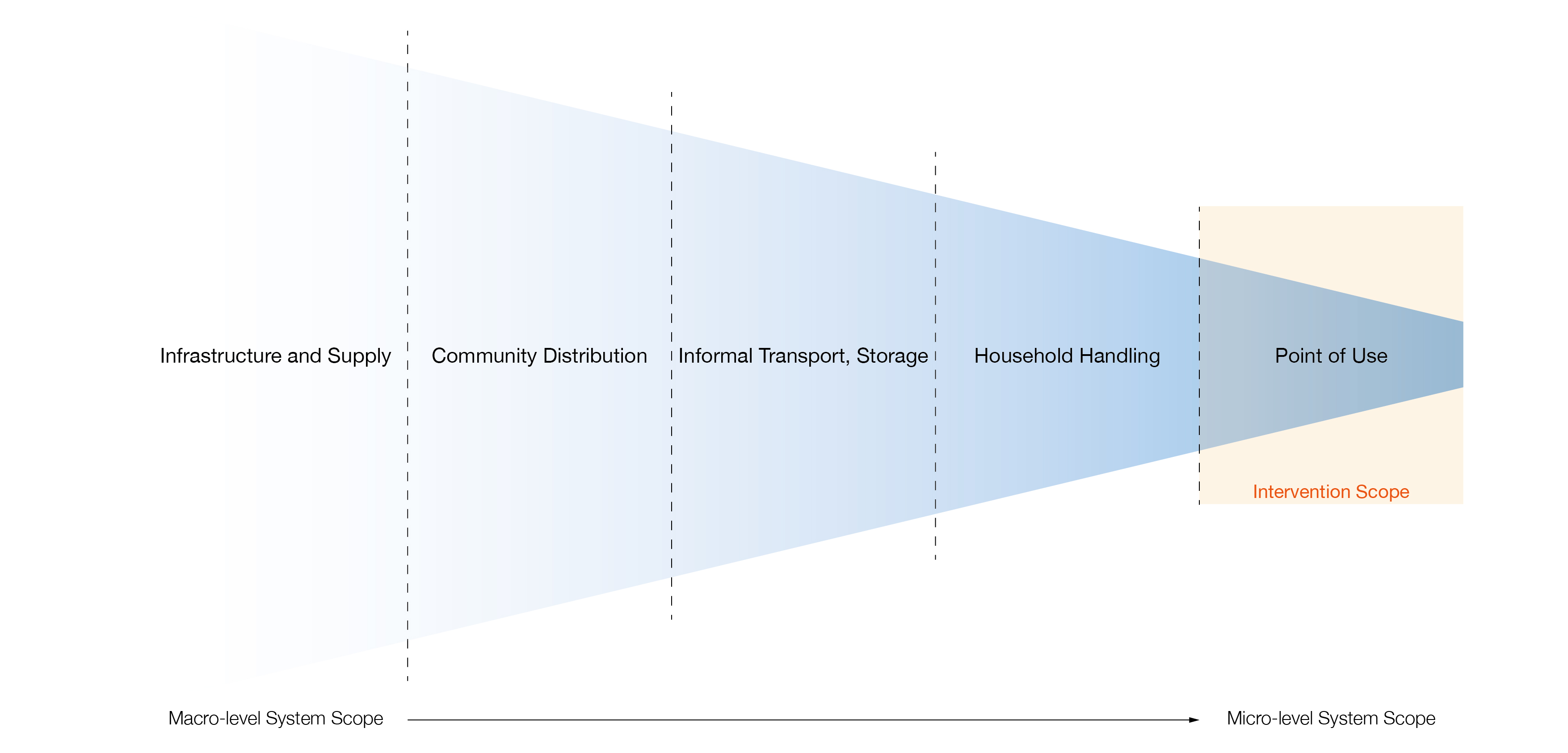
The point of use offers a final opportunity to treat water before drinking.
Water security in Mombasa spans multiple stages, each presenting different problems and possible directions for design.
We chose the point of use because water can still be treated there, regardless of what has happened upstream. It also allows a household-level product to act directly on the water before consumption, without requiring changes to the wider supply and distribution system.
•Household Water Journey
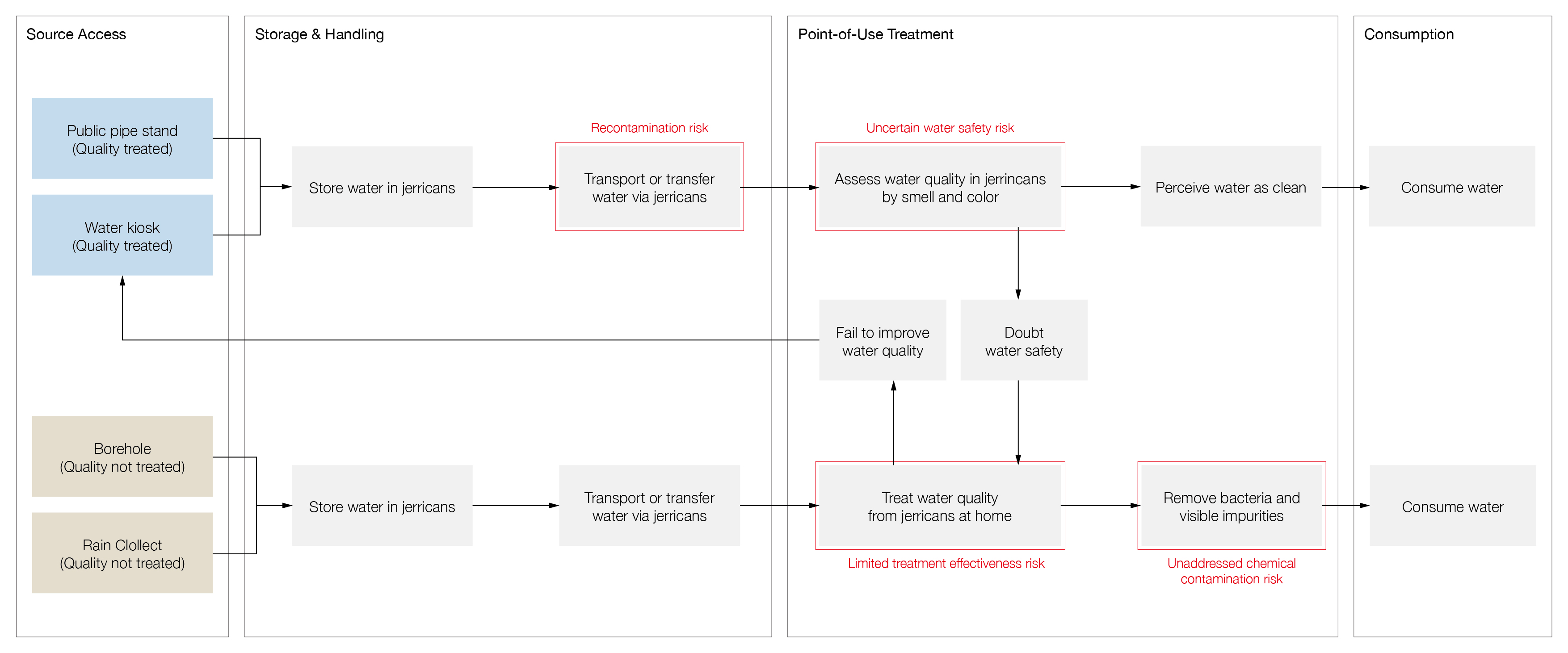
The jerrican is present at almost every step of household water use.
Mapping household water journeys through remote interviews and desk research showed that water can become contaminated again while it is carried, stored and transferred in jerricans. Households often judge water by its colour and smell, which cannot reliably indicate whether it is safe to drink.
As an existing part of these water-handling routines, the jerrican offered an interface for introducing filtration into everyday use.
•Design
A filter that mounts onto the jerrican.
Mombasa Blue attaches to the opening of an existing jerrican. A hand-operated pump draws water up through a filtration unit and into a removable cup, without requiring the container to be lifted or tilted.

Drawing water for drinking.
Water is pumped into a removable cup, which can be lifted off and poured into a drinking glass. The transparent cup keeps the water and its level visible.
01: Mounted on the jerrican.
03: Water drawn through the filter.
04: Filtered water collected in the cup.
Filtering water during transfer.
Transferring water between jerricans is already part of household water routines. For this, the collection cup is removed and tubing connects the device to both containers, allowing the same pump to draw water through the filter during transfer.
01: Collection cup removed.
02: Inlet and outlet tubes connected.
03: Water pumped between the jerricans.
04: Water passing through the filtration unit.
•Process
Ideating from a critical touchpoint.
To tackle the last-mile challenge, initial ideation focused on the local jerrican, as it anchors most water-related activities and marks the final interaction before drinking. This approach grounded concepts in existing behaviors rather than introducing new ones.
Narrowing mechanisms through performance criteria.
Building on the selected concept from Phase 01, ideation shifted toward developing the filtration mechanism itself. Concepts were then narrowed using performance-driven criteria such as water flow rate efficiency, operating force burden, and manufacturability.
Refining interaction, ergonomics, and form.
Following key decisions in earlier phases, this phase focused on refining the physical interface. Sketching was used to explore ergonomics and interaction details in preparation for further development.
Validating the concept through physical prototyping.
With the concept consolidated, this phase focused on producing a higher-fidelity physical prototype to assess physical feasibility, structural integrity, and interaction under more realistic conditions.

•Reflection
1. Purposeful design intervention starts from concrete user friction.
When facing a complex system shaped by multiple factors, it is easy to identify numerous areas for potential improvement. This project highlighted that meaningful design intervention does not come from addressing complexity broadly, but from focusing on concrete friction points within users’ daily routines. Grounding decisions in these moments helped narrow the scope and ensured the intervention remained both purposeful and accountable.
2. Make the intangible tangible.
Initial interview insights naturally pointed toward visible and tangible issues, such as the current community-driven solutions. However, mapping the full user journey revealed where these solutions quietly failed to carry through everyday use. This process exposed critical gaps at the last mile - issues that were not immediately visible, yet decisive in shaping the final design direction.
3. Looking ahead: questions for further development.
(1) From a hardware perspective, this project explored additive manufacturing as a prototyping strategy; translating the design into traditional manufacturing would introduce new constraints that could significantly reshape the form and structure.
(2) Additionally, future development would involve deeper exploration of inner filter materials and technologies to validate filtration performance under real-world conditions.
(3) More broadly, this project suggests questions about how products might respond more dynamically to their context. Future exploration could examine how emerging technologies, such as LLMs, enable physical products to better sense usage conditions and adapt interactions accordingly.